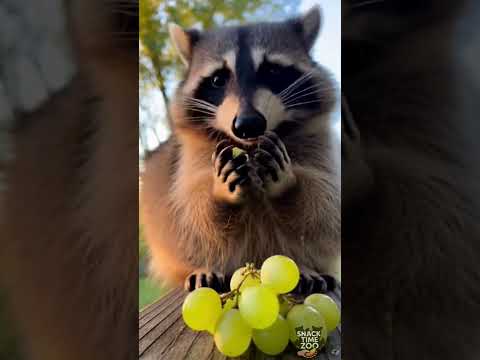
Raccoon Facts: The Masked Bandit That Washes Its Grapes to Feel Them
Our raccoon eats grapes the way a tiny human might — holding each one in both hands, turning it over, dunking it first. Behind that cute routine is one of North America's cleverest animals. Meet the raccoon, a masked night explorer whose hands are so sensitive it practically sees with its fingers.
Watch Raccoon at Snack Time Zoo:
A Built-In Bandit Mask
The raccoon's famous black mask is not just a disguise for cartoons. The dark fur absorbs glare, a bit like the eye black athletes wear, and it may help raccoons recognise each other in the dark. Behind it sits a bushy tail ringed with five to seven dark bands, used as a fat store for lean winters and as a cosy wrap when the animal curls up to sleep.
Hands That Can Almost See
A raccoon's front paws are astonishing. They carry far more touch sensors than most mammals' paws, and a huge share of the sensory part of a raccoon's brain is devoted to processing what those paws feel. Long, nimble fingers can untie knots, unlatch boxes and identify objects by touch alone — a raccoon can tell what it is holding without even looking at it.
Why Raccoons Wash Their Food
Raccoons famously dunk food in water, a behaviour scientists call dousing — it is even baked into the name lotor, Latin for the washer. They are not cleaning dinner. Wetting the paws softens the tough skin and wakes up the nerves, so damp food gives the raccoon much richer touch information. In other words, a washed grape simply feels more interesting than a dry one.
A Clever Night-Time All-Rounder
Raccoons are nocturnal omnivores, which means the night shift is theirs and almost nothing is off the menu: fruit, nuts, crayfish, eggs, insects and the odd raided picnic. They climb superbly — their hind feet can swivel right around to grip on the way down a trunk — and they swim well too. In experiments, raccoons remembered how to solve puzzles for up to three years, so never bet against one at a locked bin.
Quick Summary
The raccoon (Procyon lotor) is a masked North American omnivore with a genius for touch: super-sensitive paws, a food-dousing habit that boosts what those paws can feel, and a puzzle-solving memory that holds onto tricks for years.
Frequently Asked Questions
Why do raccoons wash their food?
Not to clean it. Dousing food in water softens the skin on a raccoon's paws and activates the touch nerves, so the animal gets much more information about what it is holding. A wet grape feels different — and more interesting — than a dry one.
Can raccoons really open locks and latches?
Yes. Their nimble fingers and strong memories make them famous escape artists. Raccoons in studies learned to open complex latches and could still remember the solution years later.
What is a raccoon's black mask for?
The dark mask cuts down glare, much like the black stripes athletes paint under their eyes, and it may also help raccoons tell one another apart at night.
Are raccoons good swimmers?
They are. Raccoons swim confidently and often hunt along riverbanks and shorelines, feeling in the shallows with their front paws for crayfish, frogs and mussels.